
What is a Dental Filling and What Happens If You Delay a Dental Filling?
You experience a cold sensation, which triggers a sudden, sharp pain. Your dentist found a tiny cavity during your previous appointment. You decided to postpone your treatment because you believed it was not urgent at that moment.
The situation sounds familiar to you. Many people experience this same situation. People tend to delay treatment for minor dental issues because their schedules fill up. Dental issues become more serious as time passes because people believe they can wait until their problems disappear. What starts as a minor fix can turn into something that takes more time, more visits, and more discomfort down the road.
The blog explains how delaying a filling can lead to specific outcomes, what the signs indicate, and what information you should consider before postponing your treatment.
What Is a Dental Filling, and Why Does It Matter?
The dental filling procedure restores oral health by repairing decayed teeth. Bacteria convert tooth enamel, which protects teeth, into a cavity, which creates a small opening. The small opening expands over time.
How does a dental filling work?
The dentist removes decayed portions of the tooth, then cleans the space before filling it with material, usually composite resin, amalgam, or ceramic. The dental procedure restores the tooth’s natural form and function while preventing further decay.
A dental filling in Amherst, OH, is one of the most common dental procedures because it combines ease of execution with successful outcomes, and it can be completed in a single treatment session.
What Happens When You Wait
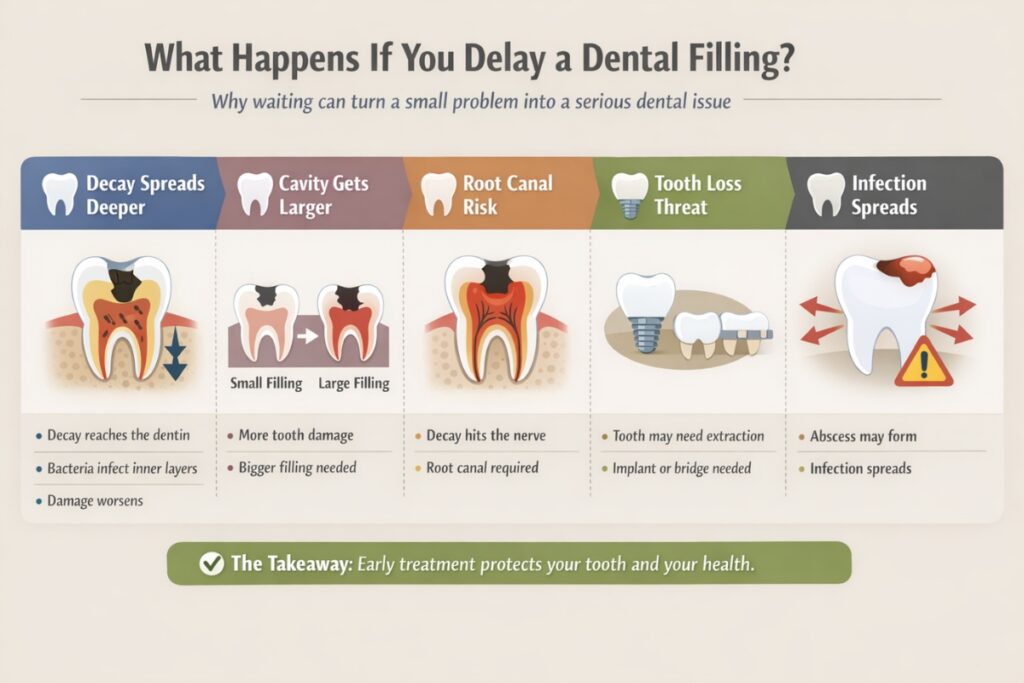
Delaying a filling doesn’t just mean living with a cavity a little longer. Here’s what actually changes:
The Decay Spreads Deeper – Tooth structure doesn’t regenerate. Bacteria begin to infect the dentin layer beneath the enamel once they enter the tooth. The nerve becomes accessible at this stage because it lies near the dentin layer.
A Small Filling Becomes Larger – Early cavities require minimal material and less of the natural tooth to be removed. Delaying treatment leads to more dental decay because more time passes, and the dentist must remove more damaged tissue to create a larger treatment area.
Root Canal Risk Increases – If the decay reaches the pulp, which contains the tooth’s nerve and blood vessels, the filling treatment will no longer work. A root canal becomes necessary. Root canal treatment is more complex than a basic filling.
The Chance of Losing Your Tooth Becomes a Real Threat – The extraction procedure is necessary because there are no remaining treatment options for the tooth. The dentist will need to discuss dental implants or bridges to replace the space created by tooth extraction.
Infection Can Spread – Dental infections can move from one tooth to another. Untreated decay can create an abscess, which may spread infection to nearby structures in extreme cases.
Signs You Shouldn’t Ignore
If you’re in the Amherst, OH area and noticing any of these, it’s worth getting checked:
- Tooth sensitivity to cold, hot, or sweet foods
- Visible dark spots or pitting on a tooth
- Food is getting stuck in the same spot repeatedly
- A dull ache that comes and goes
- Rough texture when your tongue runs over a tooth
Why People Delay — And Why It’s Understandable
There are many reasons someone may delay going to the dentist, including fear of the dentist, feeling too busy, concerns about the cost of treatment, expectations about what treatment will be like, or the hope that the problem will go away on its own. While understandable, delaying dental treatment can lead to additional problems. Teeth do not heal on their own and will not heal the same way skin does. For example, a cavity will not heal without some intervention.
The longer someone delays getting dental treatment, the more difficult it will be for them to address the situation and begin any necessary restorative procedures. The sooner the problem is addressed, the easier it will be to treat and the less it will cost.
If one reason someone has been delaying dental visits is anxiety, it is a good idea for the patient to communicate their concerns to the dentist before treatment. Many dental practices offer additional methods to help ease a patient’s dental anxiety.
Conclusion: Don’t Let “Later” Become a Bigger Problem
Having a cavity filled soon is one of the best things a person can do for their long-term oral health. A small dental filling can prevent a tooth from being lost later.
If you have been delaying getting your tooth filled, Amherst Neighborhood Dentistry is committed to providing our community with quality care, open communication, and patient comfort.
Don’t Allow Your Minor Problem Turn into a Major Issue
We can provide you with the necessary tools to make a more informed decision about your tooth. Therefore, we encourage patients to visit our office so we can meet with them to help them understand their treatment options and move forward with their dental care.
Our practice serves the communities of Amherst, Ohio, and the surrounding areas.
Common Questions People Ask
1. Can a cavity go away without a filling?
No. Once enamel has decayed, it cannot regenerate on its own. Fluoride treatments can help stop very early-stage decay (before a cavity fully forms), but an existing cavity requires professional treatment.
2. Is it okay to leave a small cavity untreated for a few months?
It’s not recommended. Even a small cavity can deepen and widen over time. The longer it’s left, the more tooth structure is lost.
3. What happens if a cavity reaches the nerve?
Once decay reaches the nerve, a simple filling isn’t enough. A root canal is typically needed to remove the infected pulp before the tooth can be restored.
4. Are dental fillings painful?
The procedure itself is done under local anesthesia, so you shouldn’t feel pain during the filling. Some mild sensitivity afterward is normal and usually fades within a few days.
5. How long after a dental filling can I eat?
You can typically eat 1-2 hours after a dental filling, but avoid hard or sticky foods for 24 hours.
